Rising Voices: Asia Pacific Art Exhibition at the V&A
What is the Rising Voices exhibition?
Rising Voices: Contemporary Art from Asia, Australia and the Pacific is a landmark V&A exhibition bringing together contemporary art from across the Asia Pacific region. Presented in partnership with QAGOMA, Brisbane, it foregrounds First Nations perspectives, ancestral knowledge, colonial histories and living systems of belief through sculpture, photography, painting, ceramics, weaving and body adornment.
Exhibition at a Glance
- What: Rising Voices: Contemporary Art from Asia, Australia and the Pacific
- Where: V&A South Kensington, London
- When: 16 May 2026 – 10 January 2027
- Why Go: Asia Pacific art, seen in London
- Tickets: From £17. Book online in advance.
About the Exhibition: Rising Voices
Rising Voices: Contemporary Art from Asia, Australia and the Pacific is one of the V&A’s most significant contemporary art exhibitions of 2026. Staged in The Porter Gallery at V&A South Kensington, it brings to London a concentrated view of artistic production from a region that is culturally immense, geographically complex and too often treated as peripheral in European museum narratives.
The exhibition has been developed in partnership with the Queensland Art Gallery | Gallery of Modern Art in Brisbane, known as QAGOMA, and draws on more than 30 years of the Asia Pacific Triennial of Contemporary Art. Since its foundation in 1993, the Triennial has become a major platform for contemporary artists from Asia, Australia and the Pacific, building a collection and a curatorial language that places Indigenous knowledge, regional histories and living traditions at the centre rather than at the margins.
At the V&A, this matters. Visitors arrive in a museum famous for design, decorative arts, fashion, sculpture, ceramics and global material culture. Rising Voices asks what happens when contemporary Asia Pacific artists speak inside that setting: not as illustrations of heritage, but as makers of urgent, layered and often politically charged works. For readers planning a wider cultural itinerary, it belongs naturally within the broader calendar of Exhibitions in London, but its voice is very much its own.
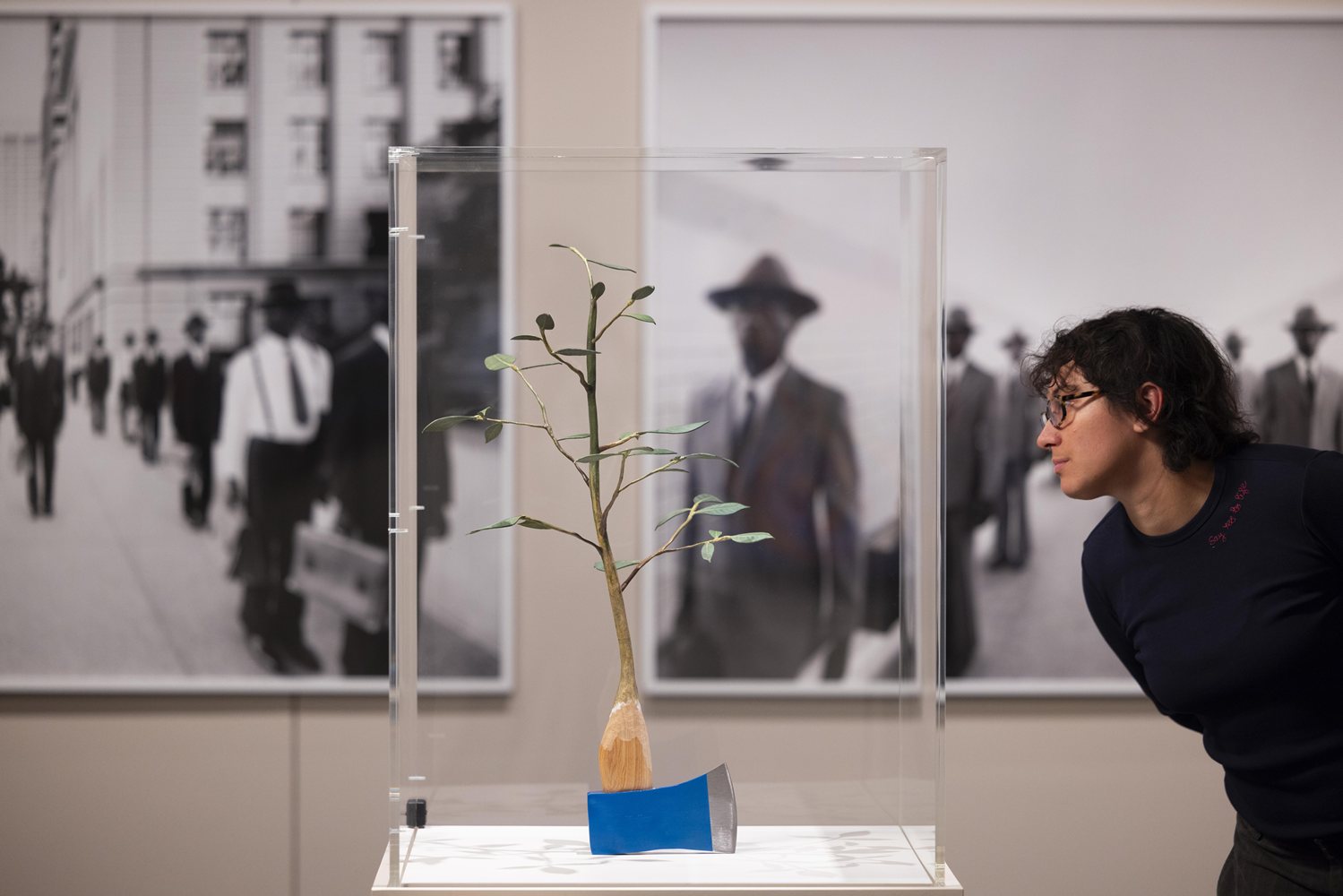
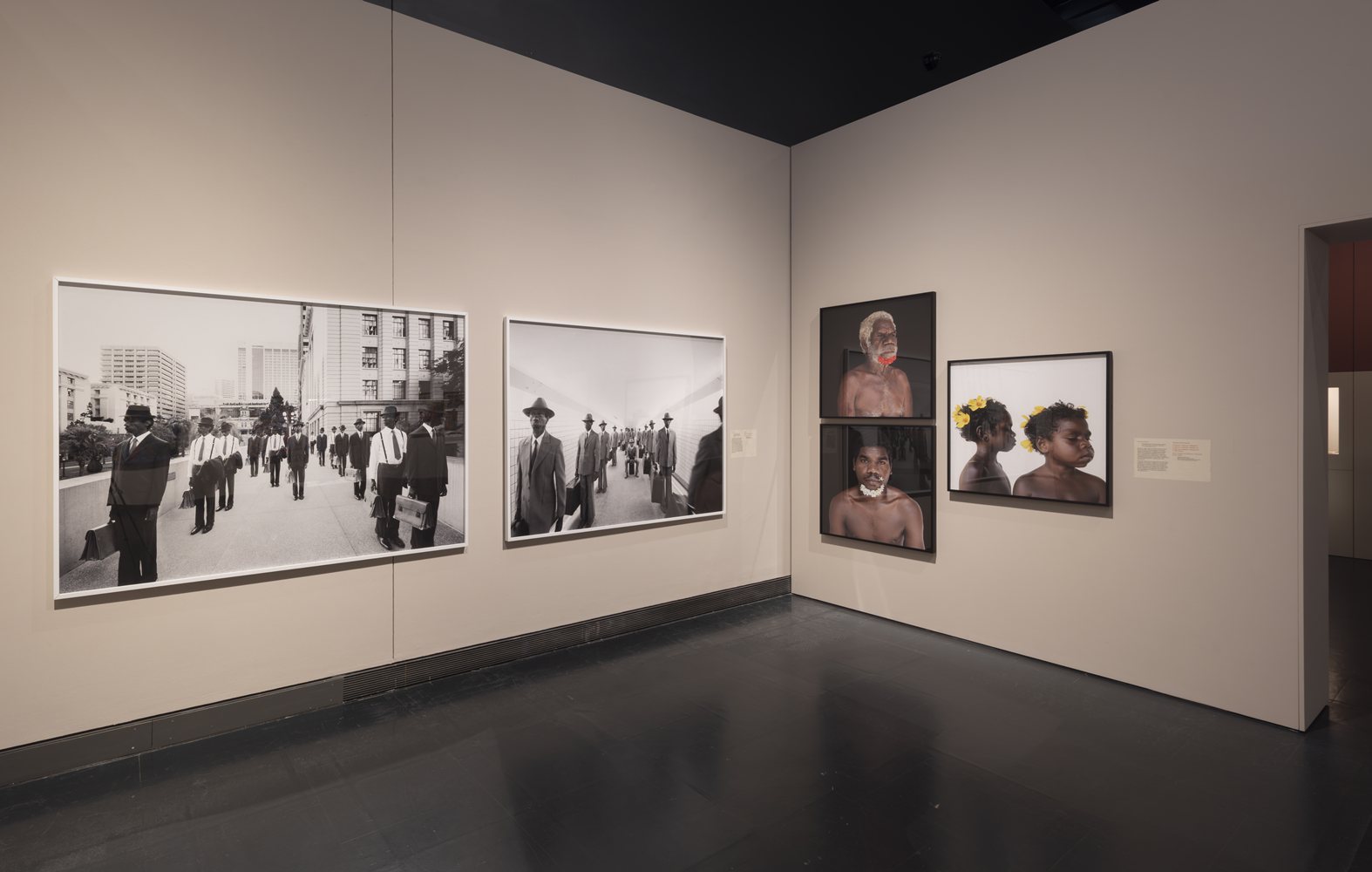
The exhibition is arranged across an introduction and three thematic sections. Re-Visioning History looks at migration, conflict, colonial mapping and social upheaval. Enduring Knowledge turns towards materials, ceremonial memory and long-standing connections to land and community. Evolving Faith considers how spirituality, belief and power move through contemporary art. The structure is clear, but the experience is not didactic: it is a sequence of encounters with works that carry histories in their surfaces, materials and forms.
Artists and Must-See Works
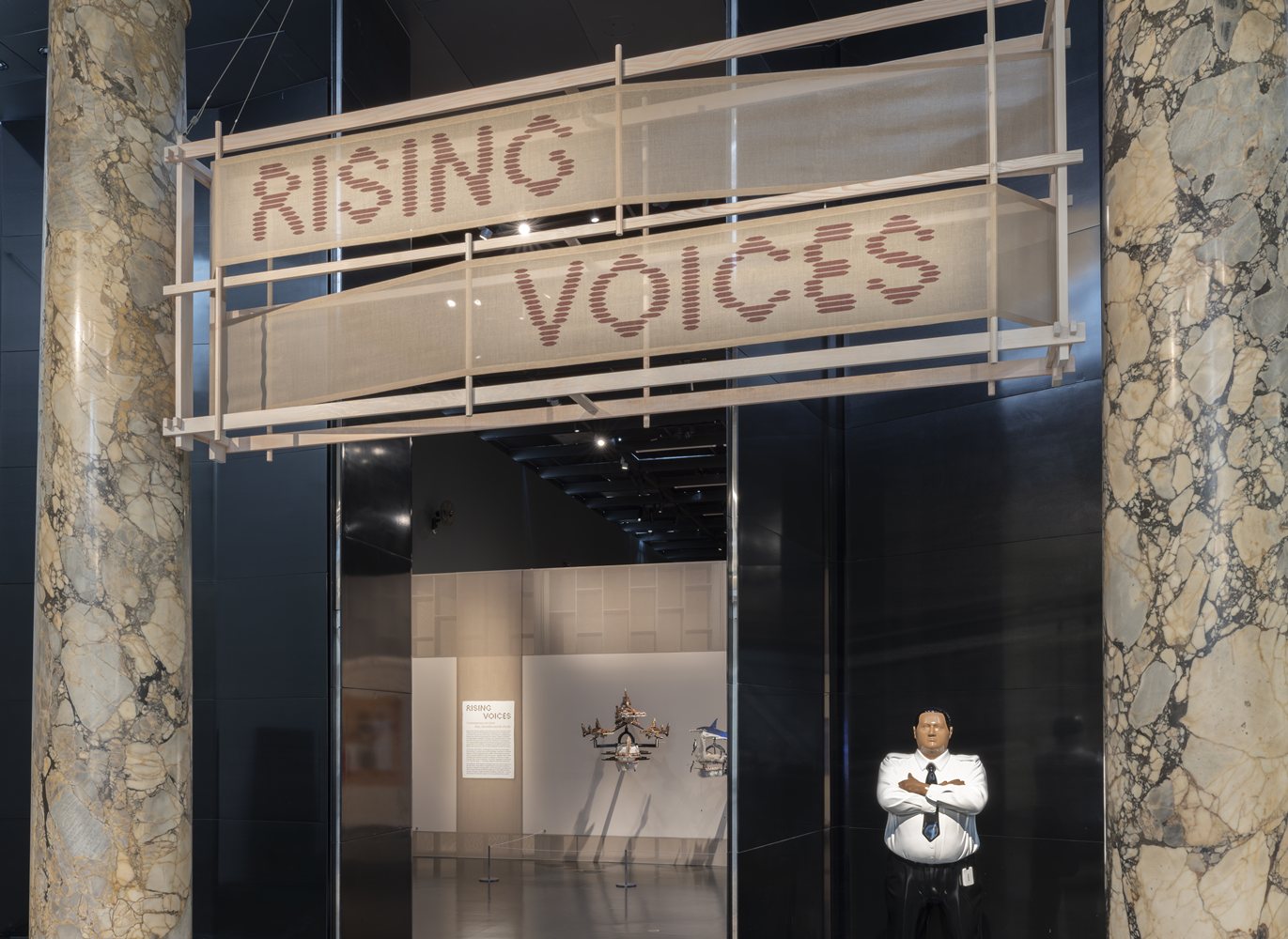
The first encounter is likely to be with Michael Parekōwhai and Kapa Haka (Whero), a life-sized fibreglass figure of a Māori security guard positioned at the exhibition’s entrance. The work stands with the stillness of someone trained to watch rather than perform. The polished surface, formal uniform and human scale create an immediate tension: is he guarding the exhibition, greeting the visitor, or asking who is allowed to stand at the threshold of a museum?
The figure belongs to Parekōwhai’s wider Kapa Haka series. Institutional sources record that the artist used his older brother Paratene, himself a security guard, as the model for the group of life-sized fibreglass figures. That detail changes how the sculpture reads. This is not an anonymous stereotype invented for the gallery; it is a personal and social image, built from a real body and a real role, and placed where visitors must negotiate its gaze before moving deeper into the show.
In the section Re-Visioning History, Pala Pothupitiye’s Kalutara Fort reworks the map as a contested object. The subject is a historic military site in Sri Lanka, first built by Portuguese occupiers, later captured by Dutch settlers and eventually surrendered to British colonial power. The work’s force lies in the way cartography becomes memory rather than neutral information: land is not simply measured, but marked by conquest, administration and erasure.
Nearby, works responding to the Bougainville conflict in Papua New Guinea bring a different historical pressure into the room. There is still a war going on in Bougainville, by Elisabet Kauage, Mathias Kauage and John Siune, looks back to a conflict that lasted from 1988 to 1998 and is described in the exhibition materials as the largest and most deadly conflict in Oceania since the end of the Second World War. The title itself refuses distance. It does not allow the visitor to file the work safely under “history”.
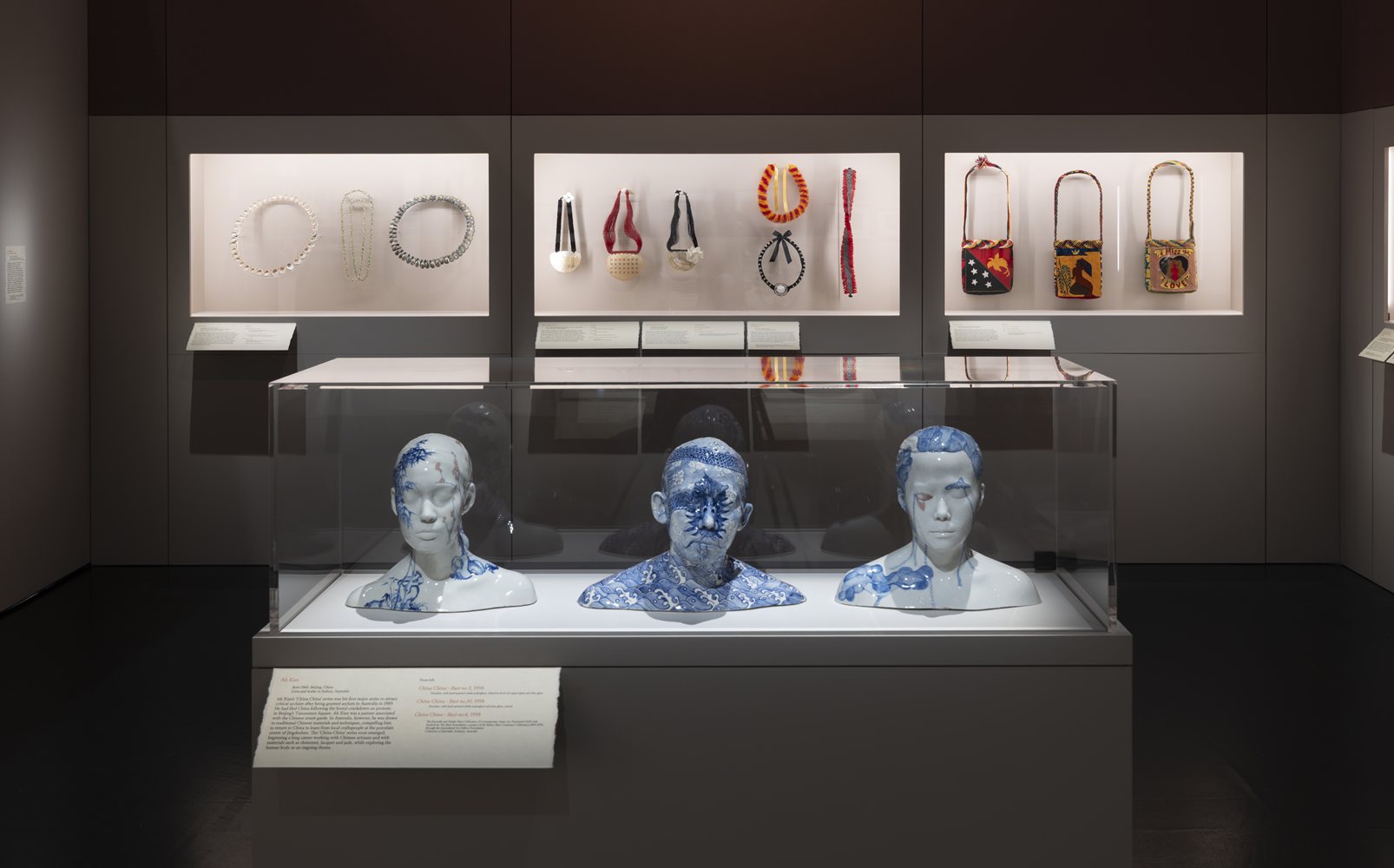
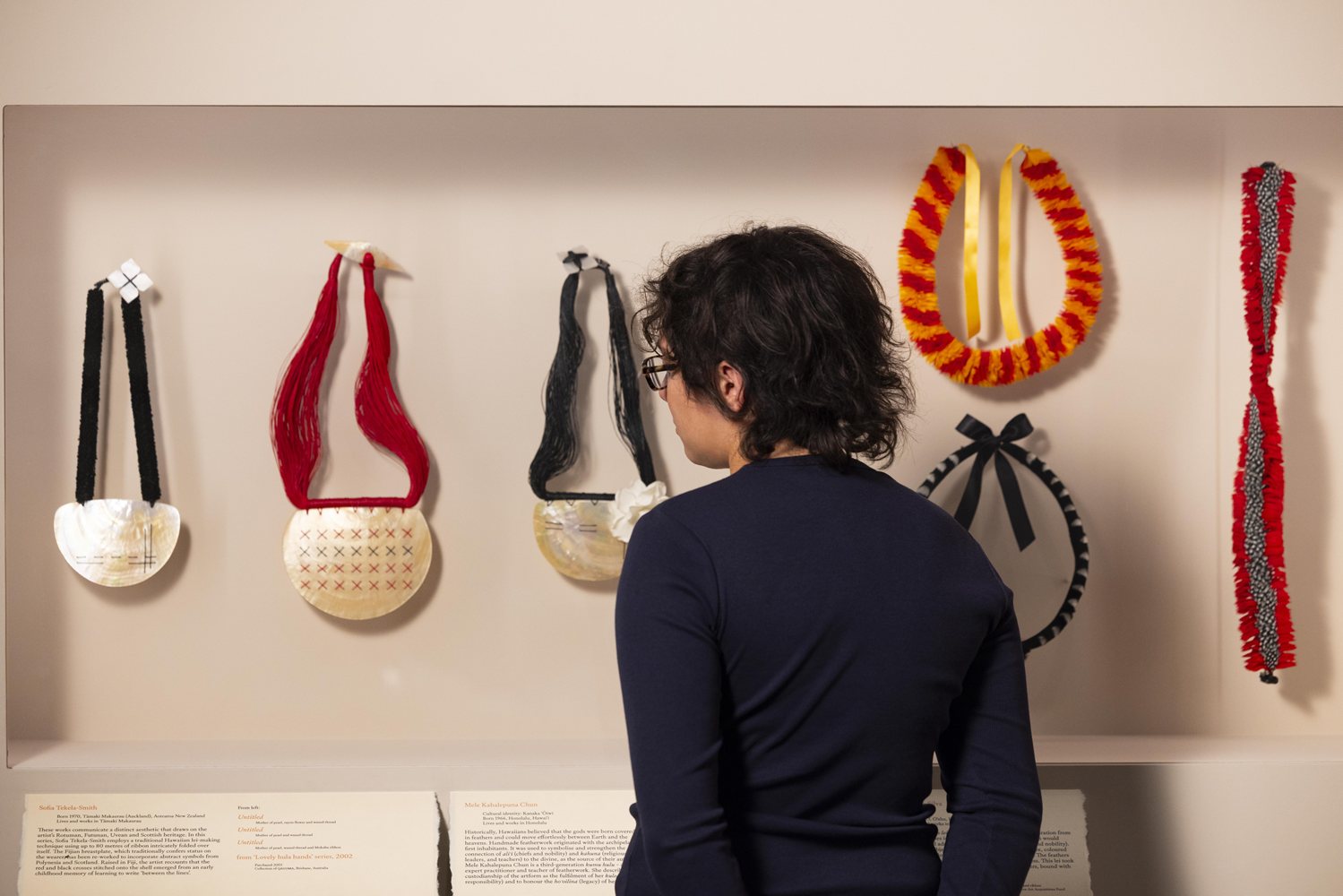
The mood shifts in Enduring Knowledge, where materials begin to carry the argument. Lola Greeno’s shell necklaces, made with maireener and abalone shells, have a quiet intensity. Their iridescent surfaces catch the light with blue, green and silver notes, but the beauty is not decorative in a simple sense. The shells speak of place, gathering, skill and continuity. They ask the visitor to look slowly, because the work is as much about knowledge held in making as it is about the finished object.
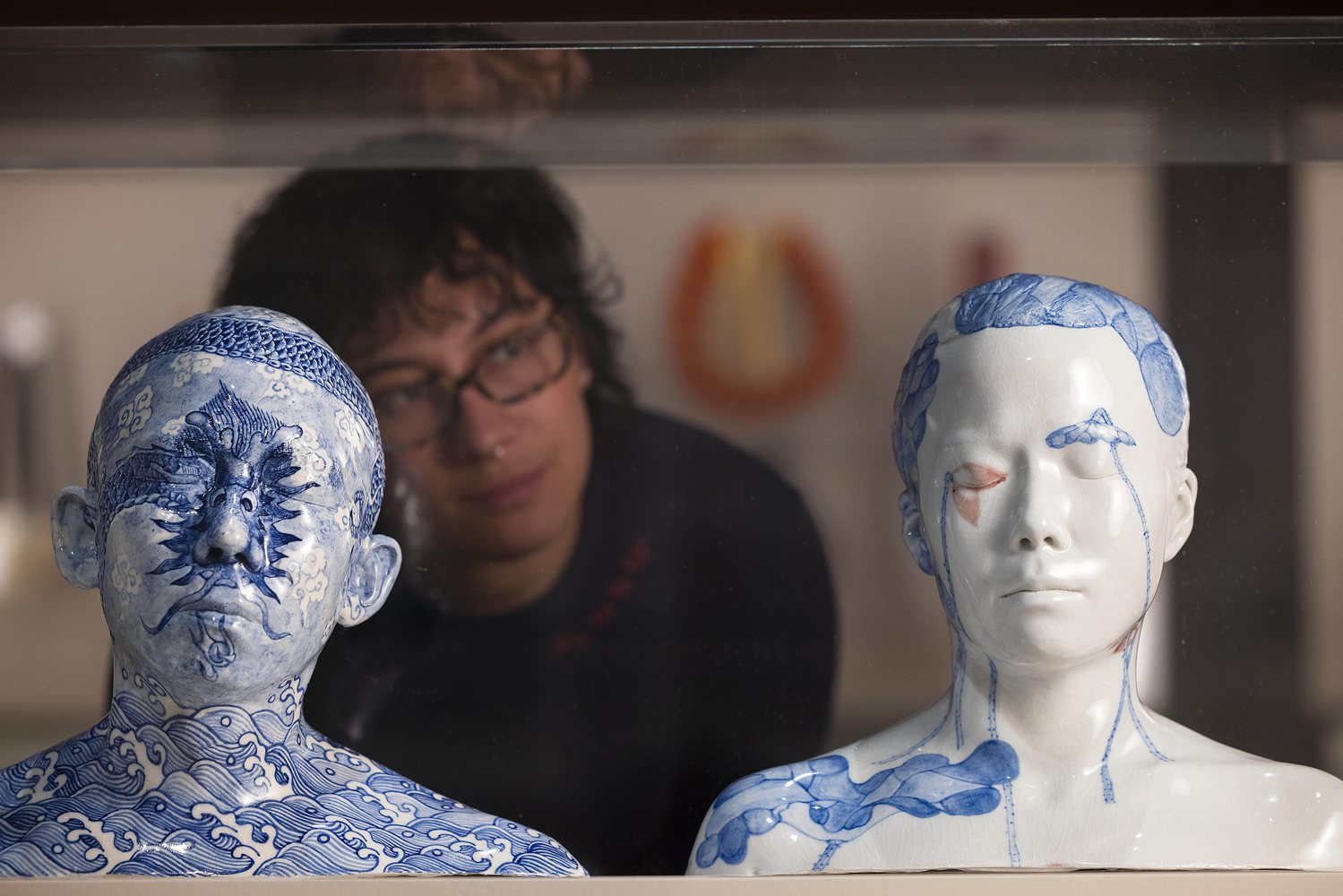
Ah Xian’s China China – Bust no. 4 takes the form of a porcelain bust cast from the figure and decorated with hand-painted cobalt underglaze. The work draws on the long history of Chinese porcelain, including traditions perfected in Jingdezhen during the Ming and Qing dynasties, but it does not simply imitate the past. A human head and shoulders become a painted landscape, as if the body itself has become a vessel for inherited images, migration and memory.
Among the works on paper, Nusra Latif Qureshi is especially important for visitors interested in how contemporary artists rethink miniature painting. Her practice challenges conventions of South Asian miniature traditions by placing female subjects at the centre. These are not simply delicate images to admire at close range; they are interventions in a visual language historically shaped by courtly, imperial and male-centred systems of representation.
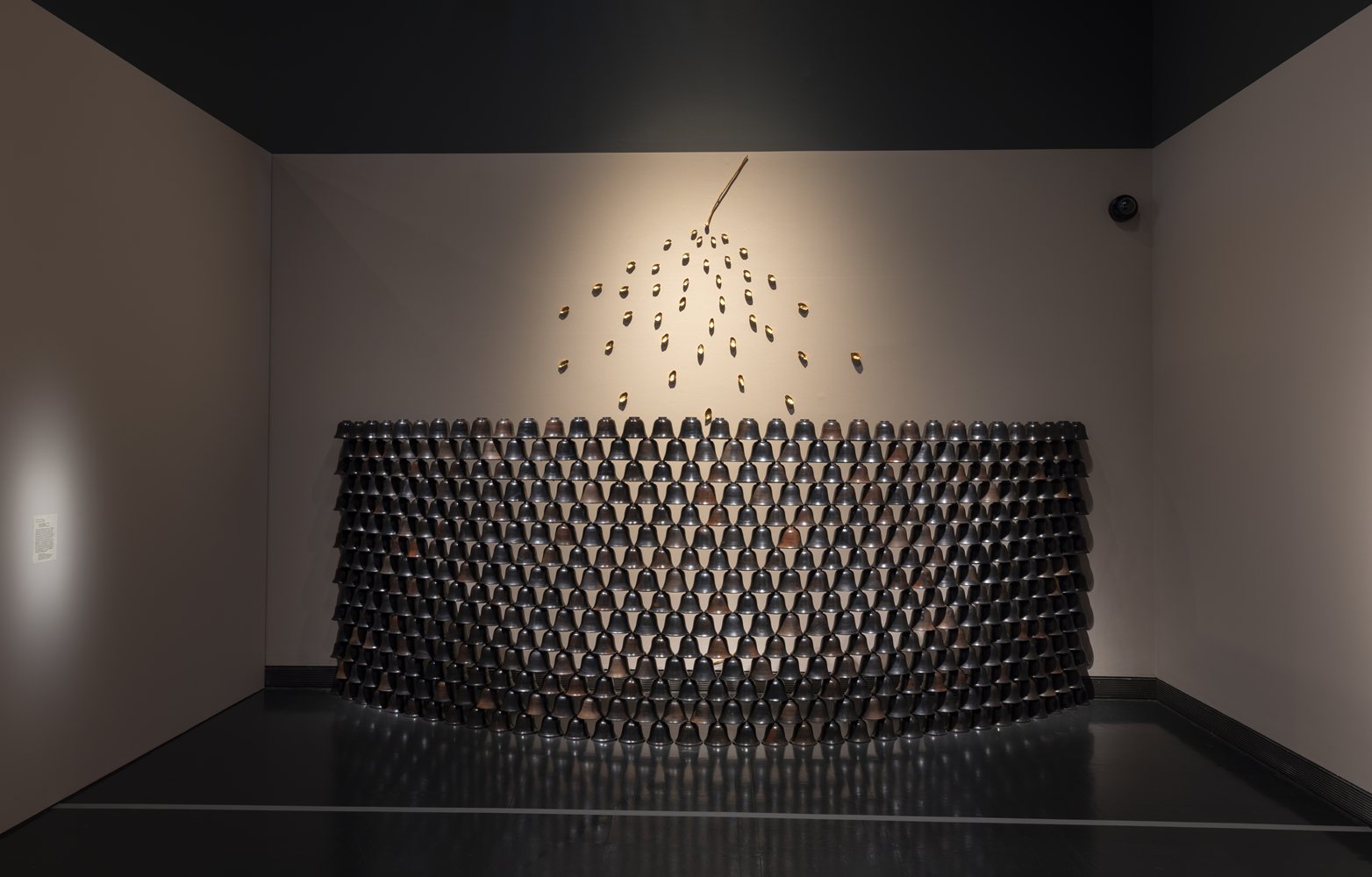
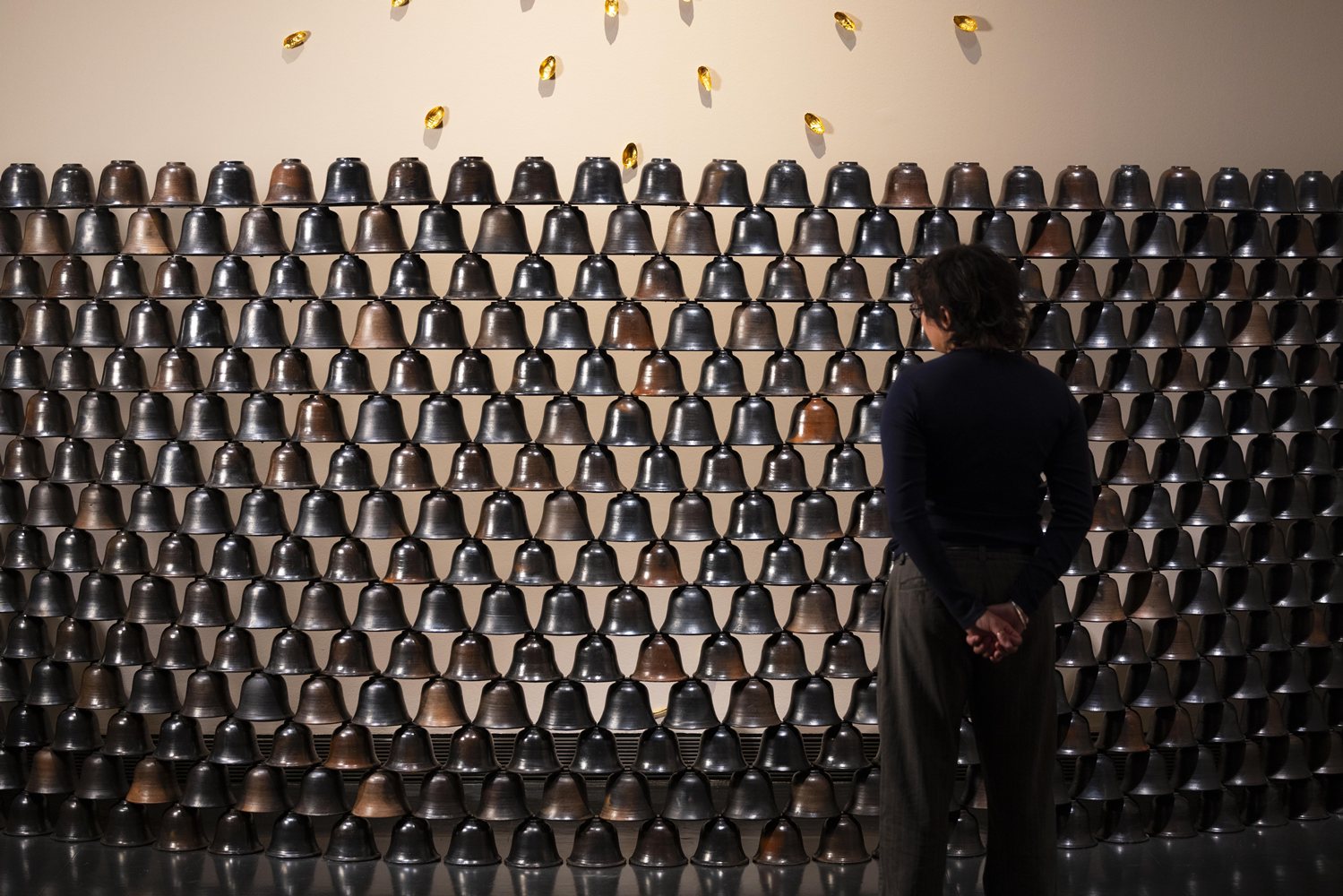
The final section, Evolving Faith, contains some of the exhibition’s most memorable works. Montien Boonma’s Lotus sound was inspired by the temple grounds of Wat Phra That Doi Suthep in Chiang Mai. QAGOMA records that Boonma found solace there in the sound of temple bells and in the sight of lotus flowers rising from murky water into bloom — a Buddhist metaphor for steps towards enlightenment. In the gallery, the work holds that memory of sound and ritual in sculptural form.
Nomin Bold’s Labyrinth game uses elements of Tibetan Buddhist thangka painting to picture the urban complexity of Ulaanbaatar in Mongolia. Its surface rewards patient viewing: the eye moves through colour, structure and symbolic detail, but the city never settles into a simple map. It feels closer to a spiritual diagram under pressure from contemporary life.
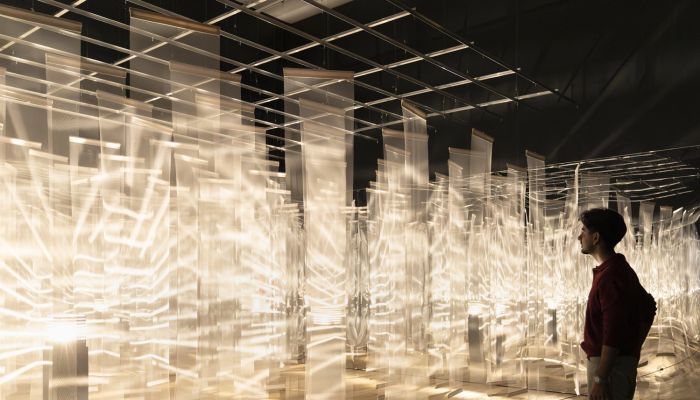
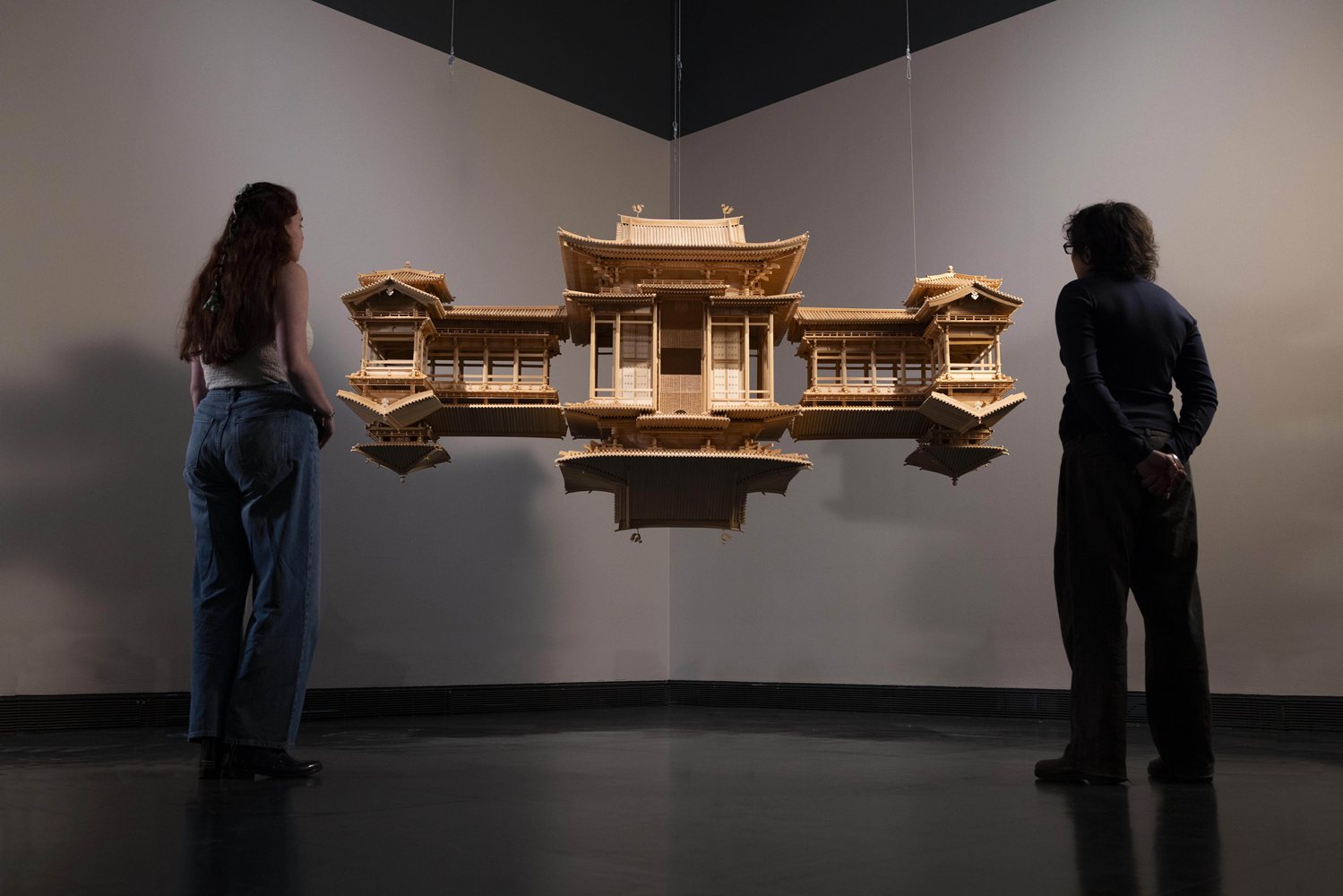
The exhibition closes with Takahiro Iwasaki’s Reflection Model (Perfect Bliss), a three-metre-long suspended sculpture made from Japanese cypress. It recreates the Phoenix Hall of Byōdō-in Temple as both building and reflection, hovering in mid-air like architecture remembered in water. The delicacy is striking: a sacred structure appears weightless, mirrored and suspended, transforming an architectural icon into an image of impermanence.
The best way to approach Rising Voices is not to look for one national story, but to follow how materials, memory and belief move across borders.
Planning Your Visit: Dates, Tickets & Tips
Rising Voices runs at V&A South Kensington from 16 May 2026 to 10 January 2027. Tickets are priced from £17, with concessions available, and the V&A recommends advance booking. This is not only sensible for availability; it also helps structure your visit, especially if you are planning a South Kensington museum day around the V&A, the Natural History Museum or the Science Museum.
Allow around 60 to 90 minutes for the exhibition if you want to read labels, pause with the major works and move through the three sections without rushing. Visitors with a strong interest in contemporary art, Indigenous perspectives, Asian art or Pacific material culture may want longer. The exhibition covers a broad region and many artistic languages, so it is better experienced slowly than treated as a quick highlights route.
For international visitors, the V&A is one of London’s easiest museums to include in a wider itinerary. South Kensington station is the most convenient Underground stop, served by the District, Circle and Piccadilly lines. The museum’s general collections are free to enter, so a ticketed exhibition visit can be combined with a shorter look at the fashion, jewellery, sculpture or ceramics galleries before or after your timed slot.
Because the show deals with colonial histories, conflict, faith and cultural inheritance, it is worth arriving with time to think rather than simply to “see everything”. Some works are visually immediate; others open slowly through context. If you are visiting London for only a few days, this is a strong choice if you want a museum experience that feels both global and specific, contemporary and deeply rooted.
Explore London’s Museums with an Expert Guide
Planning more than one museum visit in London? Our private museum tours help you make sense of the city’s great collections, from the British Museum and the National Gallery to the Natural History Museum and Tate Modern, with timed entry and expert-led commentary tailored to your interests.
Discover Private London Museum ToursWhy Visit Rising Voices?
Rising Voices is worth visiting because it gives London audiences access to works and perspectives that have rarely been seen in the UK. The exhibition is not simply a survey of contemporary art from a vast region; it is a carefully framed encounter with artists whose practices are shaped by land, migration, ceremony, political memory and systems of belief.
For visitors who do not specialise in Asia Pacific art, the show offers a clear and accessible entry point. The themes are broad enough to understand immediately — history, knowledge, faith — but the works prevent those themes from becoming abstract. A shell necklace, a porcelain bust, a reworked map or a suspended wooden temple model can each become a way into larger questions about culture, power and continuity.
What makes the exhibition distinctive is its refusal to flatten the region into a single story. Australia, Asia and the Pacific are presented through differences as well as connections. The visitor moves between Sri Lankan colonial mapping, Māori identity, Tasmanian Aboriginal shell work, Mongolian urban spirituality, Thai Buddhist symbolism and Japanese architectural reflection. The result is not a neat panorama, but something more honest: a set of voices rising from different places, sometimes in harmony, sometimes in tension.
It is also especially relevant inside the V&A. In a museum long associated with collecting, classifying and displaying global material culture, Rising Voices gives contemporary artists the space to speak back to history. That makes the exhibition valuable even for visitors who might not usually choose contemporary art. Its strongest works do not require specialist knowledge; they reward curiosity, attention and a willingness to look beyond familiar museum categories.
Practical Information
- Dates: 16 May 2026 – 10 January 2027
- Opening Hours: V&A South Kensington is open daily 10.00 – 17.45 and Friday 10.00 – 22.00. Some galleries may close after 17.45, and galleries begin clearing 30 minutes before closing.
- Location: The Porter Gallery, V&A South Kensington, Cromwell Road, London SW7 2RL
- Tickets: From £17. Concessions apply. Advance booking is recommended. Book tickets
- How to Get There: The nearest Underground station is South Kensington, served by the District, Circle and Piccadilly lines. Gloucester Road is also within walking distance.
Conclusion
Rising Voices is a thoughtful, visually rich and historically resonant exhibition that expands the way contemporary art from the Asia Pacific region is seen in London. Its strongest moments come when material beauty and difficult history occupy the same space: shells, porcelain, maps, bells and architectural models all become carriers of memory. Visit slowly, and let the exhibition’s structure guide you from history to knowledge to faith. For more ways to plan your cultural time in London, explore our private museum tours and exhibition guides.
More Temporary Exhibitions in London
Discover current and upcoming museum exhibitions across London, with practical visitor information, highlights and editorial guidance.
Browse Exhibitions in LondonPrivate Museum Tours in London
Make the most of London’s major museums with a private guide who can tailor the visit to your interests, pace and schedule.
View Private Museum ToursAuthor: The London Museum Tours Team
This article was curated by the London Museum Tours team. With years of experience guiding visitors through London's permanent collections and temporary exhibitions, our goal is to help you plan the perfect visit.
Rising Voices – FAQ
-
Do I need to book Rising Voices tickets in advance?
Advance booking is recommended by the V&A. Booking online is the safest option if you want a specific date or time, especially during weekends, school holidays or peak travel periods in London.
-
How much are tickets for Rising Voices at the V&A?
Tickets are listed from £17, with concessions available. Prices can vary by visitor category, so check the V&A booking page before confirming your visit.
-
How long should I allow for the Rising Voices exhibition?
Most visitors should allow around 60 to 90 minutes. If you want to read the labels carefully and spend time with the major works, plan for the longer end of that range.
-
Is Rising Voices suitable for visitors who are not contemporary art specialists?
Yes. The exhibition is suitable for curious general visitors because it is organised around accessible themes such as history, ancestral knowledge and faith. Some works benefit from slow looking, but specialist knowledge is not required.
-
Can I visit the rest of the V&A with the same ticket?
General admission to V&A South Kensington is free, so you can normally visit the permanent collections before or after your exhibition slot. Special exhibitions are ticketed separately.
-
Which Tube station is best for the V&A?
South Kensington is the most convenient Underground station for the V&A. It is served by the District, Circle and Piccadilly lines, and the museum is a short walk from the station.
-
Is photography allowed inside the exhibition?
Photography rules can vary between special exhibitions and individual works. Check the signs at the entrance and inside the gallery, and follow any restrictions indicated by the V&A staff or labels.
-
What else can I see near the V&A?
The V&A is in South Kensington’s museum district, close to the Natural History Museum and the Science Museum. It is also easy to combine with Kensington Gardens or a wider cultural itinerary in central London.