Renoir and Love - National Gallery Exhibition 2026
What Is the Renoir and Love Exhibition at the National Gallery?
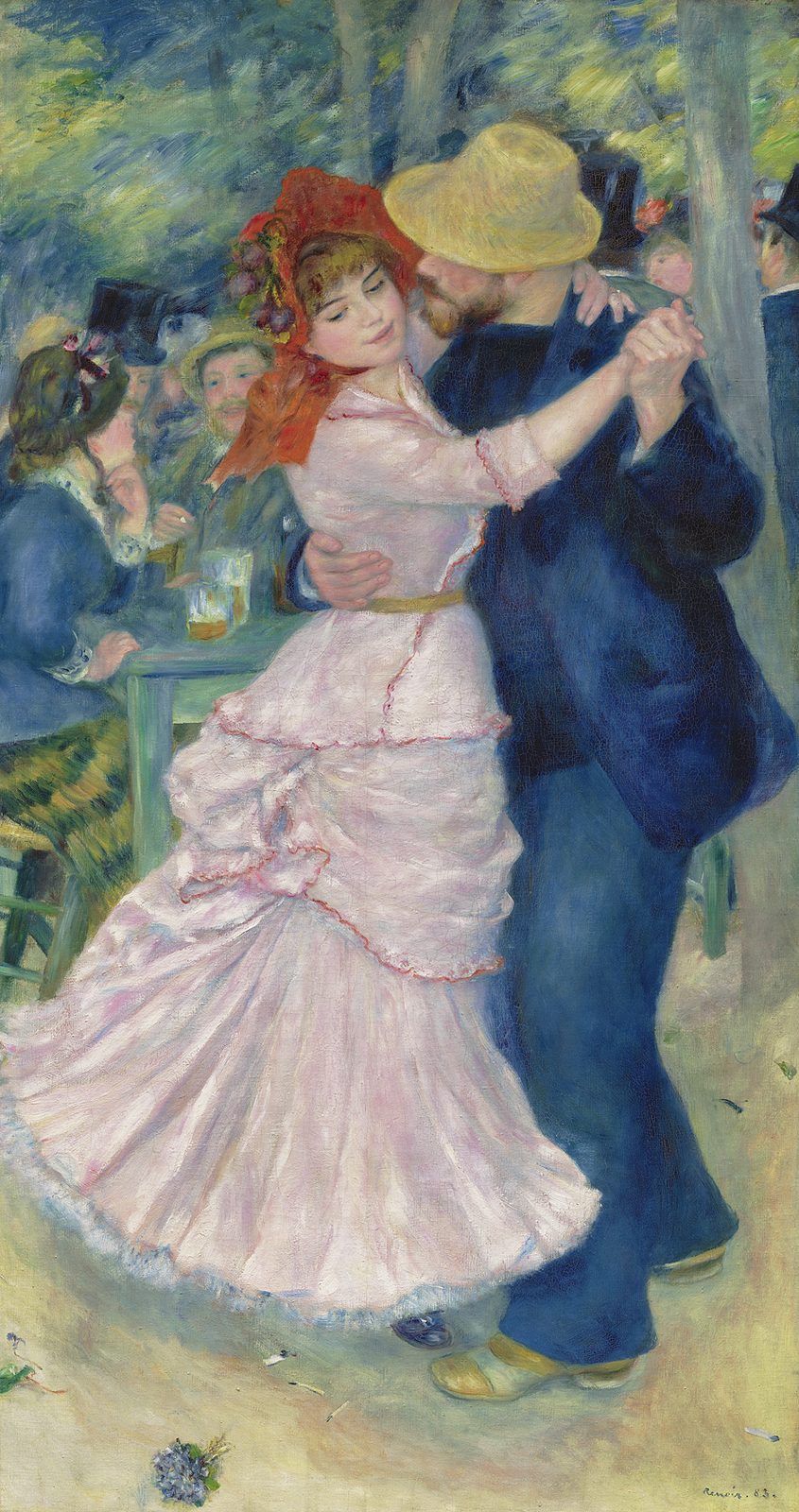
Renoir and Love is a National Gallery exhibition exploring how Pierre-Auguste Renoir pictured affection, flirtation, friendship, family life and modern sociability. Focused on his work from the mid-1860s to the mid-1880s, it reunites major paintings from international collections, including Dance at the Moulin de la Galette and Dance at Bougival.
Exhibition at a Glance
- What: Renoir and Love
- Where: The National Gallery, Sainsbury Wing, London
- When: 3 October 2026 – 31 January 2027
- Why Go: Renoir's modern relationships, reunited in London
- Tickets: From £20, sold by the National Gallery — book on the official site
About the Exhibition: Renoir and Love
Renoir and Love concentrates on roughly two transformative decades, from the mid-1860s to the mid-1880s, when Renoir turned the social life around him into one of Impressionism's most recognisable worlds. Instead of treating love as a single romantic theme, the exhibition follows its changing forms: glances exchanged in public, friends lingering over a meal, couples moving across a dance floor and the quieter physical closeness of parents and children.
This is the first National Gallery exhibition devoted to Renoir since 2007 and the most significant presentation of his work in the UK for two decades. It is organised by the Musée d'Orsay, the National Gallery and the Museum of Fine Arts, Boston. For London visitors, the importance lies not only in the quality of the loans but in the chance to see familiar images restored to their original scale: bodies are nearly life-size, tables seem to extend into the viewer's space, and crowds are held together by tiny exchanges of attention.
The exhibition also offers a useful corrective to the postcard version of Renoir. These paintings show an artist testing how modern experience could be made visible through broken light, cropped encounters and unstable points of view. It belongs naturally among the season's Exhibitions in London, while the free permanent collection provides the wider story of European painting. Our guide to the National Gallery can help you plan that broader visit.
Renoir's Key Works in the Exhibition
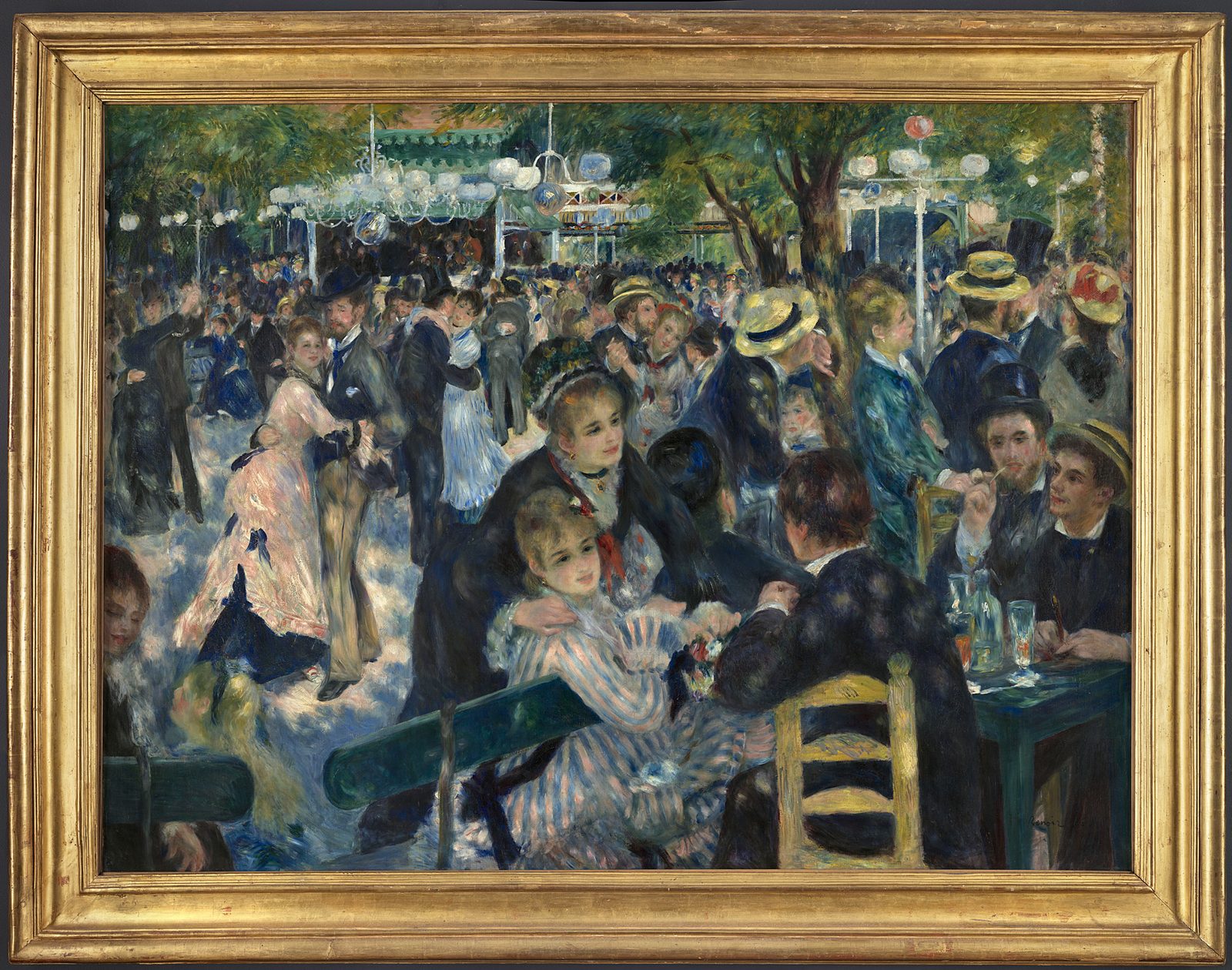
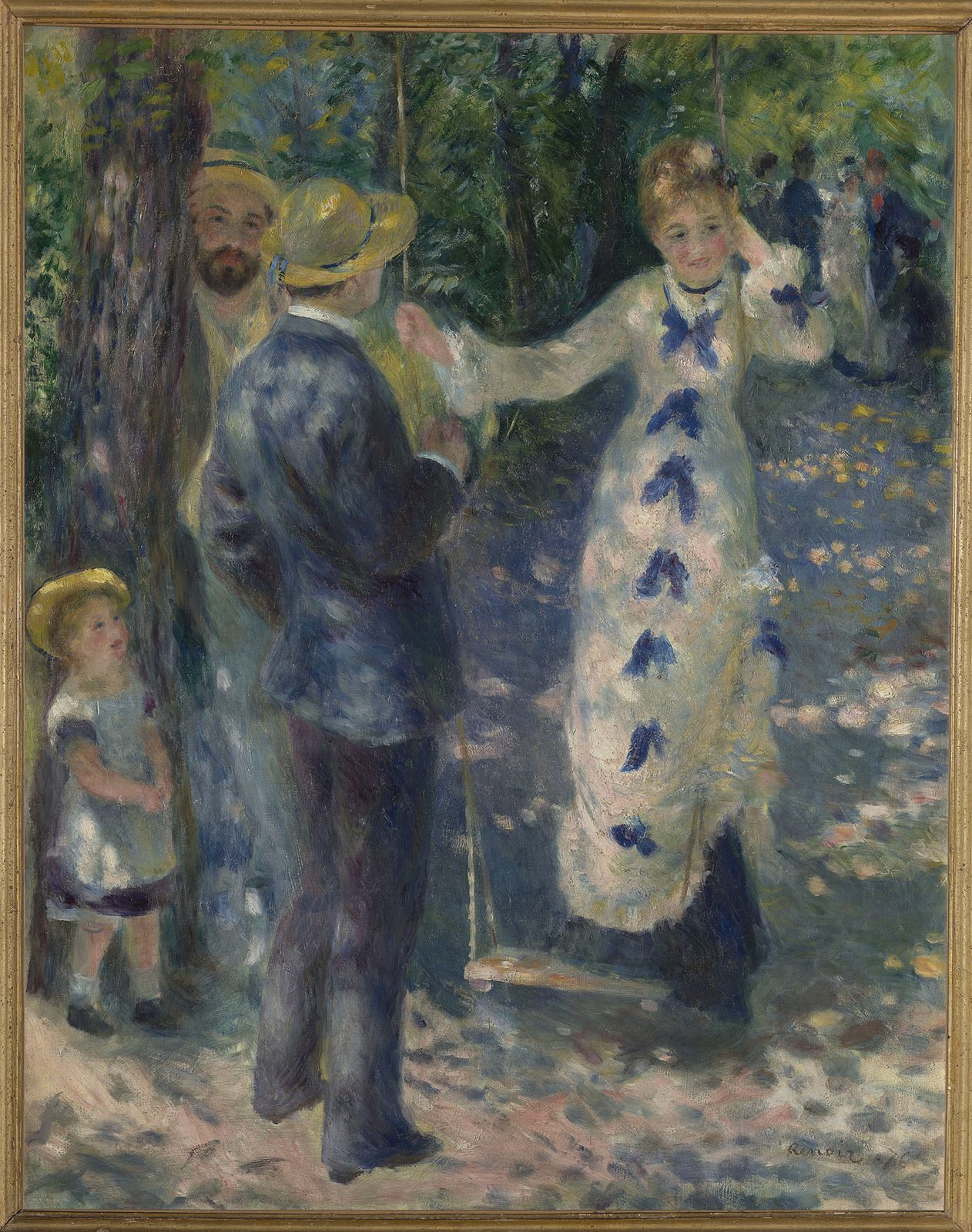
Begin with Dance at the Moulin de la Galette (1876). At 131.5 by 176.5 centimetres, it gives an everyday Montmartre dance garden the scale once reserved for history painting. Renoir worked both outdoors and in the studio, building a crowd from friends and acquaintances while spots of sun and shade slip across faces, clothes and tabletops. Look beyond the famous glow: the picture's shifting focus and multiple viewpoints were radical enough to provoke negative reactions when it appeared at the Impressionist exhibition of 1877.
Mother Antony's Tavern (1866) reveals the social circle behind the art. Renoir was only 25 when he painted this nearly two-metre-high scene of bohemian artists gathered at a tavern in Marlotte, near the Forest of Fontainebleau. Alfred Sisley sits at the right in a yellow straw hat, while an issue of L'Événement—the newspaper that published important art criticism by Émile Zola—lies on the table. After the meal, cups, peeled fruit and crumpled napkins remain; beneath Sisley's chair, the poodle Toto looks directly out and, unusually, has a wooden leg.
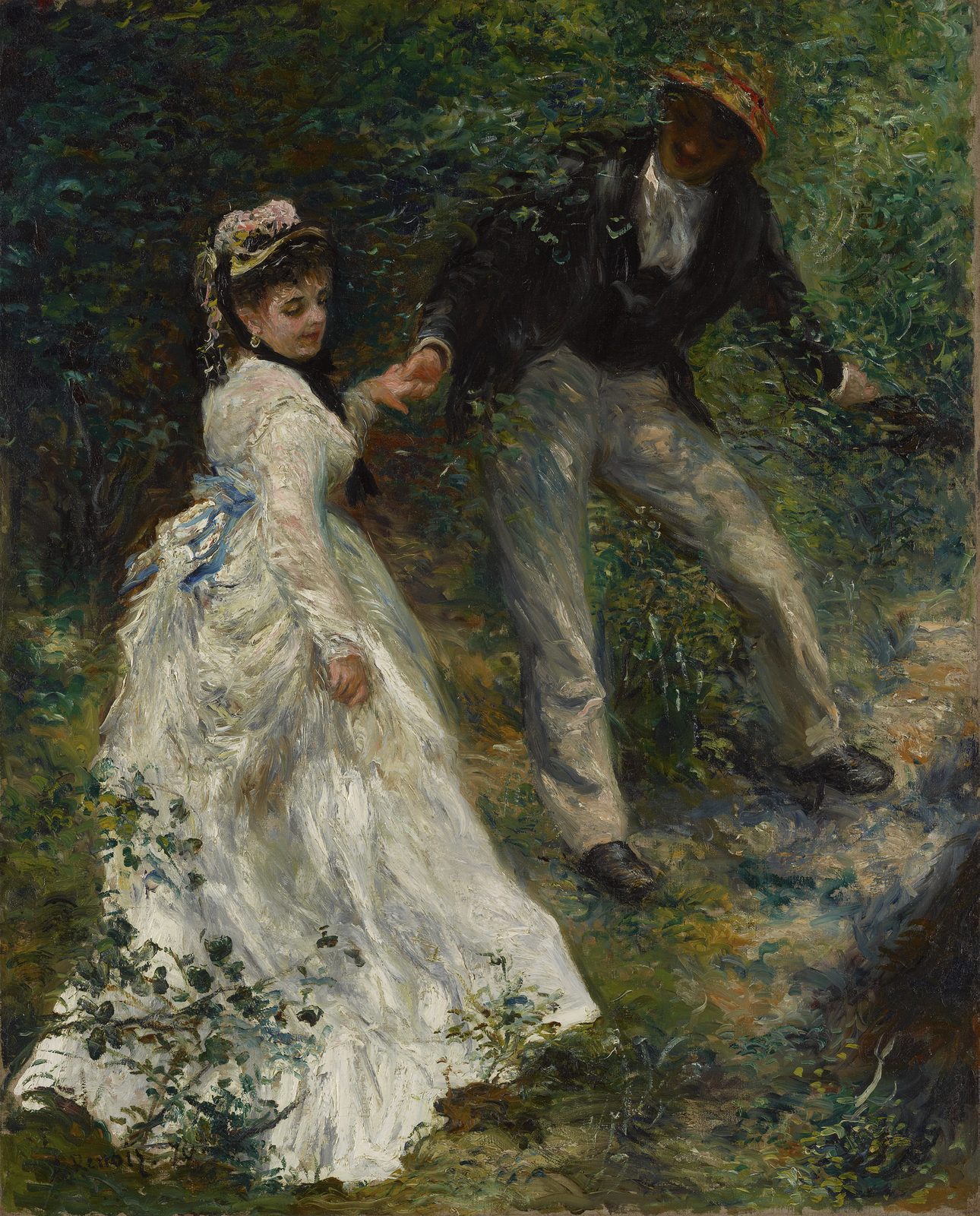
In The Promenade (1870), a man reaches back to guide a woman through dense foliage. The title was supplied by a later owner, not by Renoir, and deliberately recalls the playful garden encounters of Watteau and Fragonard. Yet the handling is decisively modern: after painting beside Monet the previous summer, Renoir adopted a lighter palette and feathery brushwork. Thin, oily glazes run into one another, so the couple seems to materialise out of leaves and flickering light rather than stand against a fixed backdrop.
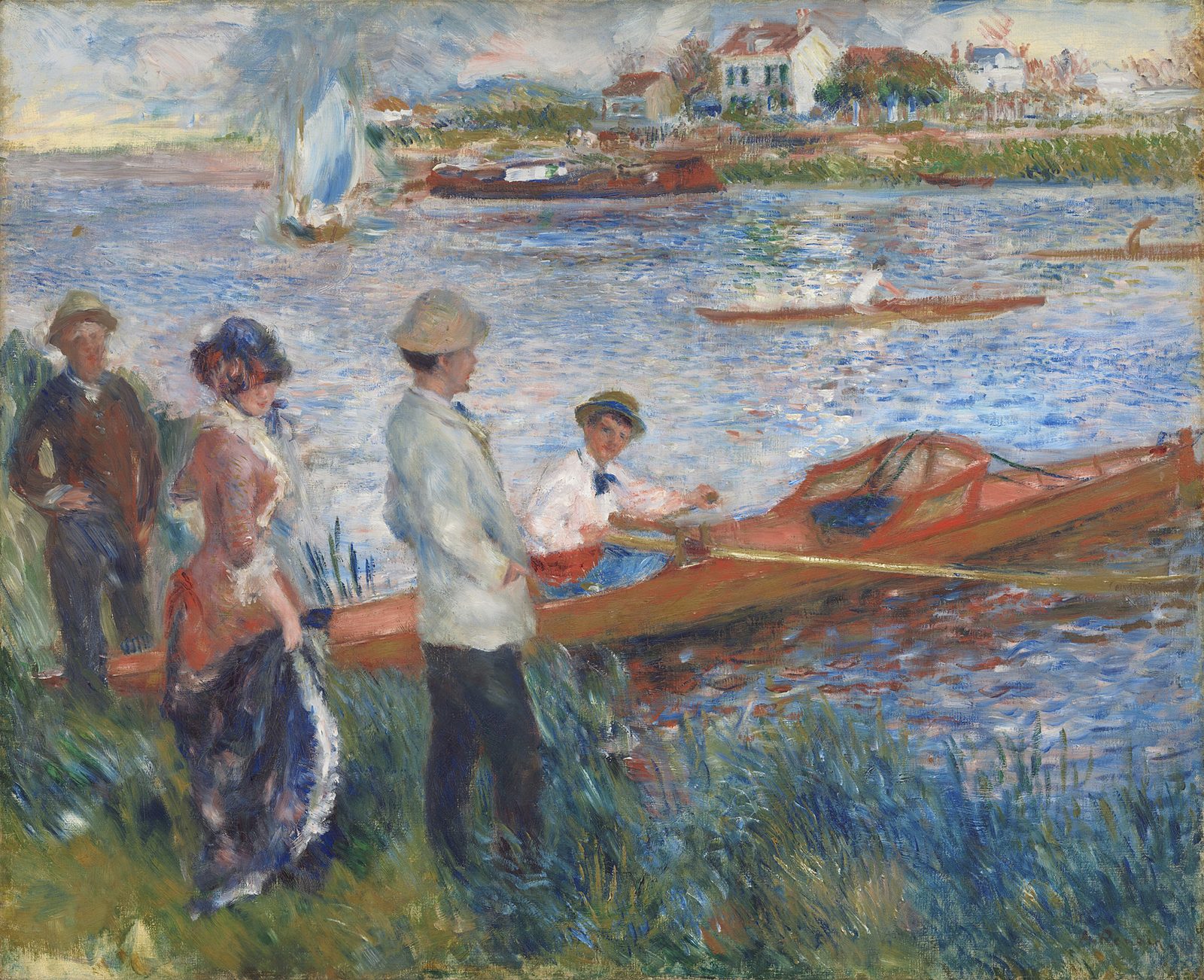
Lunch at Restaurant Fournaise (The Rowers' Lunch) (1875) places the viewer almost at the next table. Two oarsmen and a woman sit beneath a trellis at Chatou, with bottles on a silver tray, fluted glasses and fruit catching small dabs of white light. Technical research by the Art Institute of Chicago shows that Renoir painted it in several wet-in-wet campaigns and revised the figures as he worked. The canvas was shown at the second Impressionist exhibition in 1876, where one critic mocked its apparently legless boaters; seen now, its daring lies in how pure blues, yellows and lead white turn an ordinary lunch into an experiment in reflected colour.
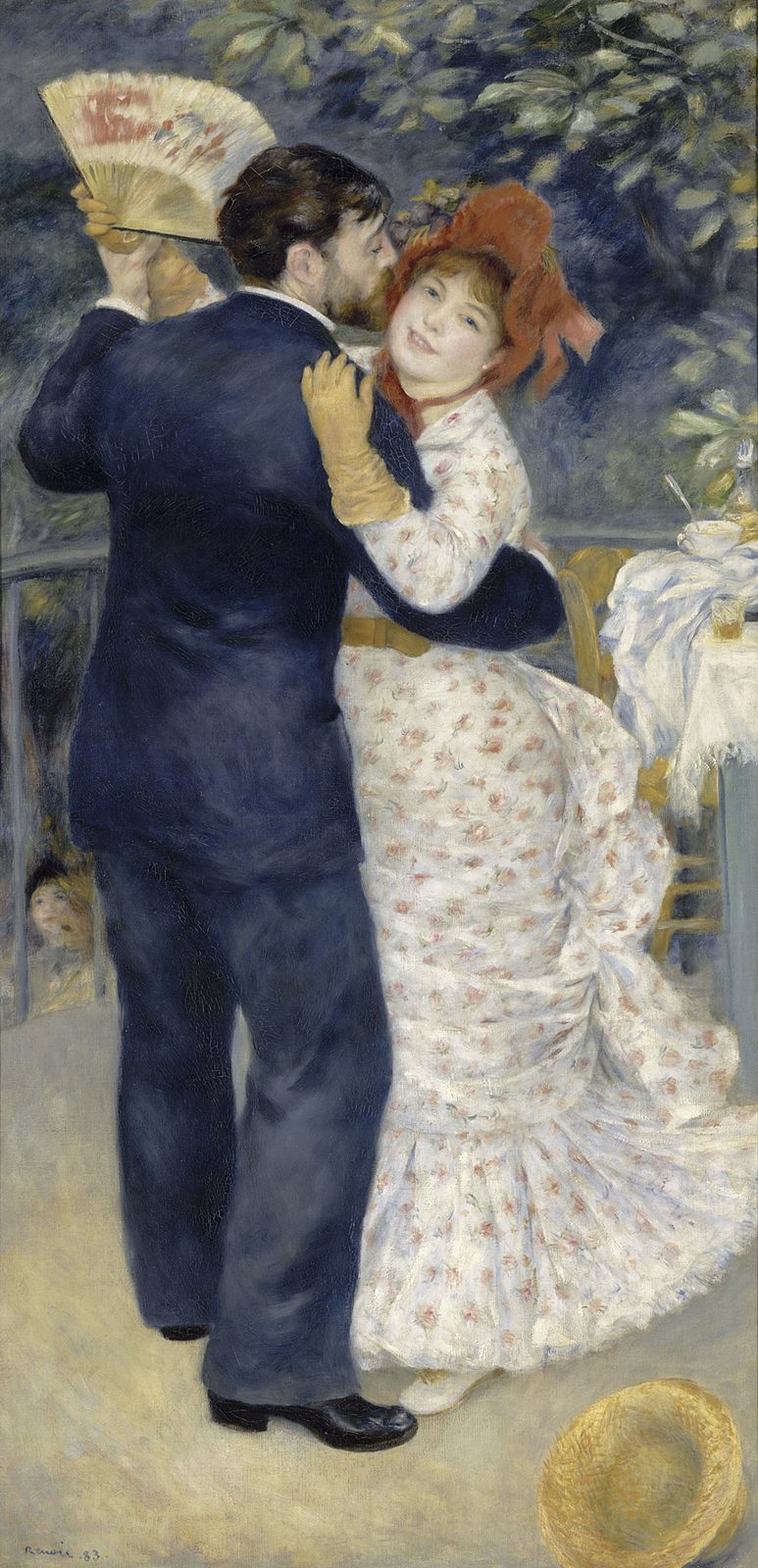
The nearly life-size Dance at Bougival (1883) is best approached from a few steps back and then close up. At a distance, the pair turns as one solid shape while the café behind them dissolves. Up close, the floor is strewn with cigarettes, burnt matches and a fallen bouquet, and the woman's red bonnet is trimmed with purple fruit. Renoir, the son of a tailor and a dressmaker, understood how clothing could carry a scene's charge. The painting was made in the studio, and its firmer, more sculptural figures signal his move towards a new classicism after the looseness of the 1870s.
Finish with Young Mother (1881), a small, intimate counterweight to the crowded dances. Renoir painted it in Naples during his only journey to Italy, as his attention was turning towards Raphael and Renaissance structure. A mother steadies the child on her lap while patterned colour holds the pair close together. The work matters because it makes the exhibition's argument quietly: for Renoir, connection could be public spectacle, flirtation or friendship, but it could also be the physical trust between two people in a room.
Planning Your Visit: Dates, Tickets & Tips
Renoir and Love runs until 31 January 2027 in the Sainsbury Wing. Timed tickets are likely to be busiest on Fridays and Saturdays, so international visitors with fixed dates should book before travelling. Allow about 75 to 90 minutes for the exhibition, and arrive early enough for security at the Sainsbury Wing entrance. Bringing minimal luggage is sensible: wheeled luggage and suitcases are not admitted, and larger bags may need to be checked.
Standard admission is £20 off-peak from Sunday to Thursday and £25 on Fridays and Saturdays, with the £25 price also applying every day during the first two weeks. Under-18s and National Gallery members enter free. Friday evenings from 23 October 2026 to 15 January 2027 include a Pay What You Wish option from £1, subject to availability through the National Gallery.
Renoir and Love requires a separate ticket sold by the National Gallery; entry to the permanent collection remains free, and you can visit it independently or with a private guide. If you are combining both, give yourself a short break between the exhibition and the main galleries rather than treating them as one continuous route.
Pair Renoir and Love with the National Gallery's Collection
Your exhibition ticket covers the show only; the National Gallery's 2,300 paintings are free, and most visitors walk past the ones they came for. A private tour with an art historian, timed around your exhibition slot, takes you from the Van Eycks to the Impressionists without the guesswork.
See the National Gallery Private TourWhy Visit Renoir and Love?
Renoir's popularity can make his originality difficult to see. This exhibition restores the risk beneath the pleasure: a major canvas devoted to an ordinary dance hall, a luncheon assembled from flashes of primary colour, or a couple whose intimacy is suggested by gloveless hands and the debris beneath their feet. The subject may be love, but the real experience is watching a painter invent ways to register fleeting attention.
You do not need to be an Impressionism specialist to follow that story. The exhibition is organised around recognisable human situations—meeting, talking, dancing, parenting—and the loans let you compare how Renoir's technique changes across them. For visitors who think they already know the artist, the early bohemian interiors and the firmer figures of the 1880s are likely to be the surprise.
Practical Information
- Dates: 3 October 2026 – 31 January 2027
- Opening Hours: Daily 10am–6pm; Friday until 9pm. Closed 24–26 December and 1 January. Check the timed-ticket calendar for exhibition availability.
- Location: The National Gallery, Sainsbury Wing, Trafalgar Square, London WC2N 5DN
- Tickets: £20 off-peak Sunday–Thursday; £25 Friday and Saturday and every day during the first two weeks; under-18s and members free, sold by the National Gallery — official ticket office
- Guided tours: Not available inside the exhibition. Our private tour of the National Gallery covers the permanent collection and can be booked for the same day.
- How to Get There: Charing Cross is the closest Tube and rail station; Leicester Square and Embankment are also within about a 10-minute walk. For step-free Tube travel, the National Gallery recommends Tottenham Court Road or Westminster; Charing Cross rail station has step-free access and is about 200 metres away.
Renoir and Love: Our Verdict
Renoir and Love succeeds because it treats intimacy as both a subject and a way of looking. Its strongest paintings reward attention to the smallest social signals: a hand without a glove, an abandoned bouquet, a newspaper on a tavern table or light breaking across a white shirt. Give the exhibition time, then use the National Gallery's permanent collection to place Renoir's experiments within the longer history of European painting. Explore our museum guides and private collection tours when planning the rest of your London visit.
Author: The London Museum Tours Team
This article was curated by the London Museum Tours team. We run private guided tours of the permanent collections of London's great museums, and we write about the city's temporary exhibitions to help you plan the perfect visit. We do not sell exhibition tickets: they are available only from the host museum.
Renoir and Love – FAQ
-
Where can I buy tickets for Renoir and Love?
Tickets are sold only by the National Gallery, online at the official ticket office or at the museum subject to availability. London Museum Tours does not sell exhibition tickets and cannot book them on your behalf.
-
Can I visit Renoir and Love with a London Museum Tours guide?
No. Temporary exhibitions are visited independently with your own ticket; our private tours cover the permanent collection of the National Gallery only. Many visitors combine the two on the same day: a 2-hour guided tour of the collection, then the exhibition, or the reverse.
-
How do I combine Renoir and Love with a guided tour of the National Gallery?
Book your exhibition slot first with the National Gallery, then choose a tour time that ends about 30 minutes before it or starts 30 minutes after. Allow 60–90 minutes for the exhibition and 2 hours for the tour; entry to the permanent collection is free. See tour details and availability.
-
How long should I allow for Renoir and Love?
Allow about 75 to 90 minutes for a comfortable visit. Add time for security and a short break if you also plan to see the National Gallery's free permanent collection.
-
Can I take photographs inside Renoir and Love?
The National Gallery permits personal, non-commercial photography in exhibitions unless a label says otherwise. Flash, tripods, selfie sticks, gimbals and additional lighting are not allowed, and individual loan paintings may carry their own restrictions.
-
Is Renoir and Love suitable for families?
The exhibition's themes of friendship, dancing and family life are accessible to younger visitors, although the presentation is designed for a general museum audience rather than specifically for children. Under-18s enter free with tickets issued by the National Gallery; timed availability should still be checked before visiting.
-
Does Renoir and Love have reduced-price Friday evening tickets?
Yes. On Friday evenings from 23 October 2026 to 15 January 2027, the National Gallery offers Pay What You Wish admission from £1 for this exhibition. Tickets remain subject to availability and must be obtained from the National Gallery.